
Quantifying Transition Zone Radiative Effects in Longwave Radiation Parameterizations
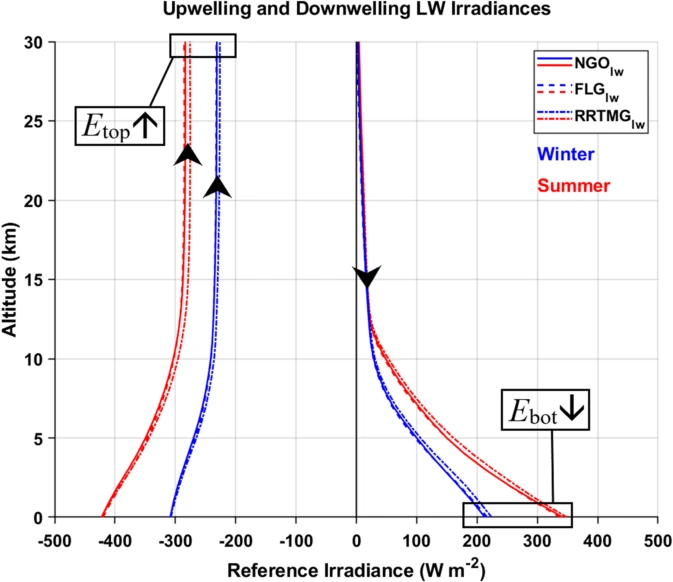
The change in the state of sky from cloudy to cloudless (or vice versa) comprises an additional phase called “transition zone,” in which the characteristics of the particle suspension lay between those corresponding to a pure cloud and those of atmospheric aerosols. This phase, however, is usually considered, in atmospheric monitoring and modeling, as an area containing either aerosol or thin clouds. This study quantifies the uncertainties that this binary assumption may introduce to the estimation of longwave radiative effects at the top and bottom of the atmosphere by using the Fu‐Liou‐Gu (FLG), NewGoddard, and Rapid Radiative Transfer Model for General Circulation Model (RRTMG) radiative parameterizations included in the Weather Research and Forecasting Model. The results show that there are important differences between optically thin clouds and aerosols in longwave region, which may cause substantial uncertainties in the radiative effects at the top and bottom of the atmosphere (up to 60 W m−2) if they are used to approximate transition zone conditions. Results are important due to the role that longwave radiation plays in the radiative balance that drives the Earth’s climate.
Access to the publication in Geophysical Research Letters