10-15% of cloudless-to-cloud transition occurrence, assessed from downwelling longwave measurements
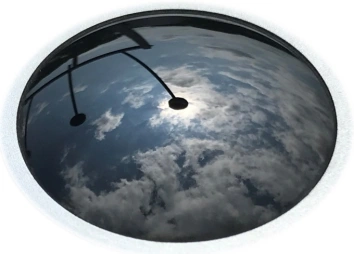
Image: clouds reflected onto a pyrgeometer dome
In a recently published article, the authors have reinforced the idea that among 10-15% of sky conditions would correspond to the cloudless-to-cloud transition zone. This result has been found from pyrgeometer measurements taken at the radiometric station of the Environmental Physics Group (Department of Physics – Polytechnic School – Universitat de Girona).
The extension of methods for estimating the occurrence of transition conditions (or the spatial extent of the transition region) is largely significant, given the importance of clouds’ effects on the climate balance.
The article, Assessment of cloudless-to-cloud transition zone from downwelling longwave irradiance measurements, has been published in Atmospheric Research.
ABSTRACT:
The transition zone has been defined as corresponding to atmospheric conditions between cloud-free (albeit containing a suspension of dry particles, i.e. aerosol) and clouds (air containing a suspension of highly hydrated particles, i.e. droplets or ice crystals). Since clouds significantly affect the infrared radiation reaching the Earth’s surface, broadband infrared measurements, which are usually performed with pyrgeometers, are implicated in some of the methods proposed for detecting clouds. The present work uses one of these methods to characterize the transition between cloud-free and cloudy conditions. Two years of downwelling longwave irradiance measured with a pyrgeometer located in Girona (in the northeast of the Iberian Peninsula) have been used to determine the values of a cloud detection index. The method must be previously tuned against a set of selected cloud-free cases to detect cloudiness to a certain confidence level. The effect of changing the detection confidence level was studied and used to derive the occurrence of transition conditions. The performance of the cloudiness detection method, with the support of observations by broadband shortwave instruments, ceilometer retrievals and images captured by hemispherical camera, was then analyzed for some short time periods. The duration of the transition periods is presented here, showing that 41% are very short (10 min, the temporal resolution of the detection method), that the median of the distribution is about 20 min, and that, although periods of more than one hour are observed, longer durations steadily decrease in frequency. It was found that 10–15% of the observations included may correspond to the transition zone, thus strengthening the estimations from other shortwave-based methods that are only suitable for daylight periods.
Link to the article:
https://www.sciencedirect.com/science/article/pii/S0169809523000546