Cloud-Aerosol Transition Zone: longwave radiative effect based on CERES observations
By Babak Jahani, Hendrik Andersen, Josep Calbó, Josep-Abel González and Jan Cermak.
Publication: https://doi.org/10.5194/acp-22-1483-2022
The study presents an approach for quantification of cloud-aerosol transition zone broadband longwave radiative effects at the top of the atmosphere (TOA) during daytime over the ocean, based on satellite observations and radiative transfer simulation. The authors used several products from MODIS (Moderate Resolution Imaging Spectroradiometer) and CERES (Clouds and the Earth’s Radiant Energy System) sensors for the identification and selection of CERES footprints with horizontally homogeneous transition zone and clear-sky conditions. For the selected transition zone footprints, radiative effect was calculated as the difference between the instantaneous CERES TOA upwelling broadband longwave radiance observations and corresponding clear-sky radiance simulations. The clear-sky radiances were simulated using the Santa Barbara DISORT Atmospheric Radiative Transfer model fed by the hourly ERA5 reanalysis (fifth generation ECMWF reanalysis) atmospheric and surface data. The CERES radiance observations corresponding to the clear-sky footprints detected were also used for validating the simulated clear-sky radiances. We tested this approach using the radiative measurements made by the MODIS and CERES instruments onboard the Aqua platform over the south-eastern Atlantic Ocean during August 2010. For the studied period and domain, transition zone radiative effect (given in flux units) is on average equal to 8.0 W per square meter, although cases with radiative effects as large as 50 W per square meter were found.
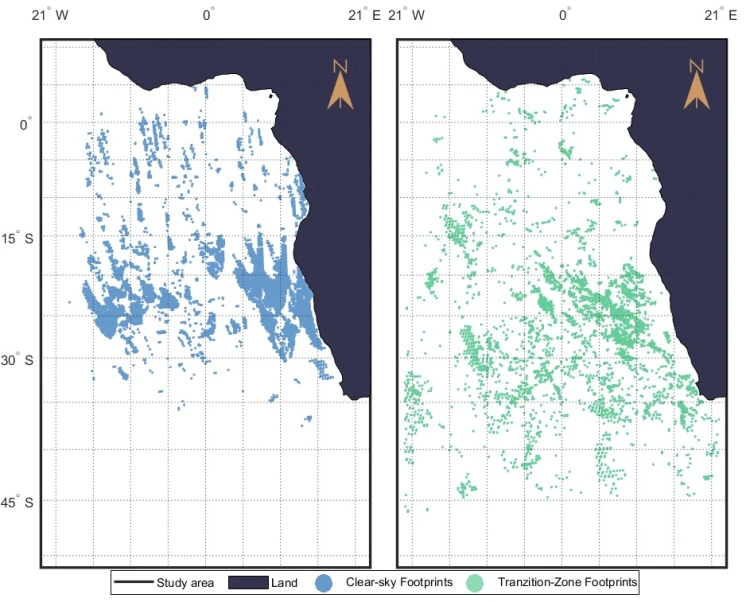
Spatial distribution of the clear-sky and transition zone CERES footprints detected within the study area (21ᵒ W-21ᵒ E, 10ᵒ N-50ᵒ S) in August 2010.