Saharan dust intrusions along February 2021
In recent weeks several episodes of intrusion of Saharan dust have affected the Iberian Peninsula and other parts of Europe. We show here how these episodes have been detected by different instruments which are routinely measuring in the stations managed by Nubesol-2 researchers.
We can observe, in the movie for February 3rd, the Moon trajectory during the nighttime, and the Sun trajectory during the daytime. Both Moon and Sun show reduced aureole, in correspondence with the low aerosol load in the atmosphere for that period. Contrarily, in the movie showing sky evolution along February 6th, and during the daytime period, the Sun shows a large aureole, due to Mie scattering of radiation caused by the dust particles in the atmosphere.
The effects of the dust in the atmosphere were also observed in the radiant fluxes (irradiances). The plot in the right shows how the irradiances measured at the Girona station (41.972N, 2.829E) evolved between February 3rd and February 6th.
The shown period starts before the strong dust intrusion arrived in the Iberian Peninsula. The morning of February 3rd shows the typical evolution of irradiances for clear periods: a smooth evolution (but slightly affected by the presence of some thin clouds), high beam (reaching 900 W m-2) and global irradiances, and low diffuse irradiance (less than 100 W m-2 at solar noon).
The radiative conditions changed dramatically when the Saharan dust intrusion arrived after February 5th. The measurements of February 6th show, despite cloudiness was relatively low, a strong reduction in the direct beam radiation, in correspondence with the increasing of diffuse irradiance due to the scattering caused by the high load of dust particles in the atmosphere.
The Vaisala CL-31 ceilometer is an instrument which emits a laser beam upwards to the sky and detects the reflected beam travelling back to the ground. The laser can not be seen by the human vision because it has a wavelength in the near-infrared spectral range. This instrument is designed to detect clouds, but the one located at the Girona station was also able to detect the effects of the dust intrusion after 5th February. The plots show a colored representation of the evolution of the backscattering profiles in the 7km of atmosphere just in the vertical sight of view of the instrument (located at 115 m altitude above sea level). Both days 3rd and 6th February are shown, and the contribution of the atmospheric dust in the backscattering is very noticeable for the second day.
Other strong Saharan dust intrusions over Europe take place from days 20th to 22nd February. The image in the right was published by NASA, and shows how huge dust plumes were advancing to the West across the tropical Atlantic Ocean, but part of them were deviated to the North in 18th February, reaching other parts of Africa or drifting North toward Europe. The animation shows in detail how conditions evolved over the North of Africa and the Iberian Peninsula from the 14th to the 24th February.
This dust intrusion combined with precipitation clouds when reached the Northeast of the Iberian Peninsula, inducing some episodes of dirty rain. The movie shows how this rain littered the transparent dome of the SONA hemispherical camera.
Evolution of sky along February 3rd, from midnight to midnight, as captured with a SONA hemispherical camera. At the end of the afternoon a solar halo caused by high thin clouds can be observed. During some nighttime periods the clouds can be observed thanks to the illumination coming from the city. Note that in this and the other movies the fast changes in the illumination close to sunrise and sunset periods are caused by the programmed adjustment of camera exposition (by steps) to adapt it to night or day conditions.
Evolution of sky along the February 6th, from midnight to midnight, as captured with the SONA hemispherical camera.
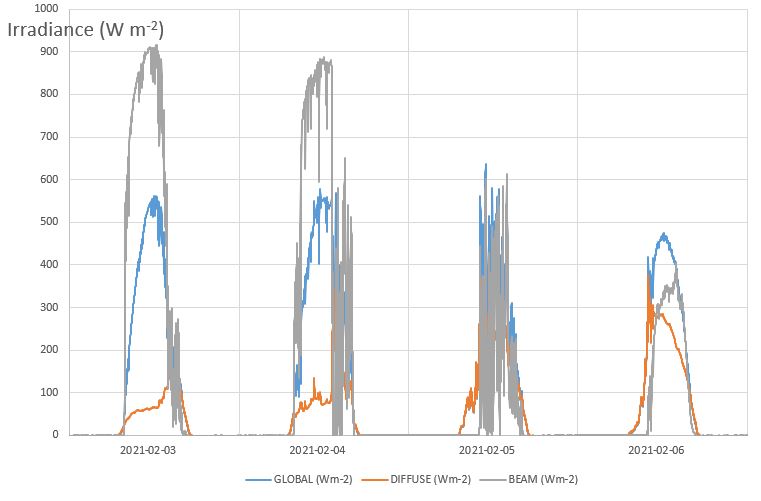
Evolution of solar global, direct and diffuse irradiances measured at Girona (NE of the Iberian Peninsula) from 3rd to 6th February 2021. Global and diffuse irradiances in the horizontal plane are measured by Kipp and Zonen CMP21 calibrated pyranometers, whereas the direct (beam) component is measured by a Kipp and Zonen CH-1 pyrheliometer.
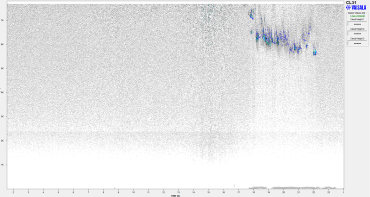
Ceilometer observation along February 3rd. Only some thin clouds were detected in the afternoon. The blue points represent the altitude of the detected cloud base.
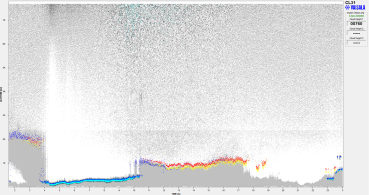
Ceilometer observation along February 6th. After a cloudy period which prevented the dust detection during the night and the early morning (blue points), the aerosol (Saharan dust) layer was detected above the station (yellow and orange points).
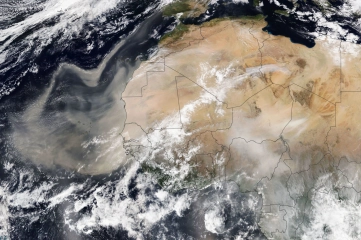
Saharan Dust Heading for Europe (nasa.gov)
More Saharan dust intrusions affected the Iberian Peninsula from 20th to 22th February 2021. This animation shows the evolution of the conditinos over the Iberian Peninsula for the period 14th to 24th February, as seen by the MODIS sensor onboard the Terra satellite. I has been captured from the imagery Worlview service of NASA. Go to the Worldview page.
During the night from 21st to 22nd, the dirty rain accumulated dust in the transparent dome of the SONA camera.