
Quantifying Transition Zone Radiative Effects in Longwave Radiation Parameterizations
The change in the state of sky from cloudy to cloudless (or vice versa) comprises an additional phase called “transition zone,” in which the characteristics of the particle suspension lay between those corresponding to a pure cloud and those of atmospheric aerosols. This phase, however, is usually considered, in atmospheric monitoring and modeling, as an area containing either aerosol or thin clouds. This study quantifies the uncertainties that this binary assumption may introduce to the estimation of longwave radiative effects at the top and bottom of the atmosphere by using the Fu‐Liou‐Gu (FLG), NewGoddard, and Rapid Radiative Transfer Model for [...]
Assessing Rapid Variability in Atmospheric Apparent Optical Depth with an Array Spectrometer System
A method for determining rapid variations in atmospheric optical depth is proposed. The method is based upon computation of the ratio between close-time spectral measurements of solar direct flux. Use of the ratio avoids the need for absolute calibration of the instruments and minimizes the effects of changes in instrumental conditions (such as temperature or mechanical adjustments) and in air mass. The technique has been applied to some campaigns of measurement for sky conditions ranging from clear skies to scattered-to-broken cloudiness, performed at high frequency (~1Hz) with a system of three array spectrometers, capable of performing very rapid spectral acquisitions, [...]
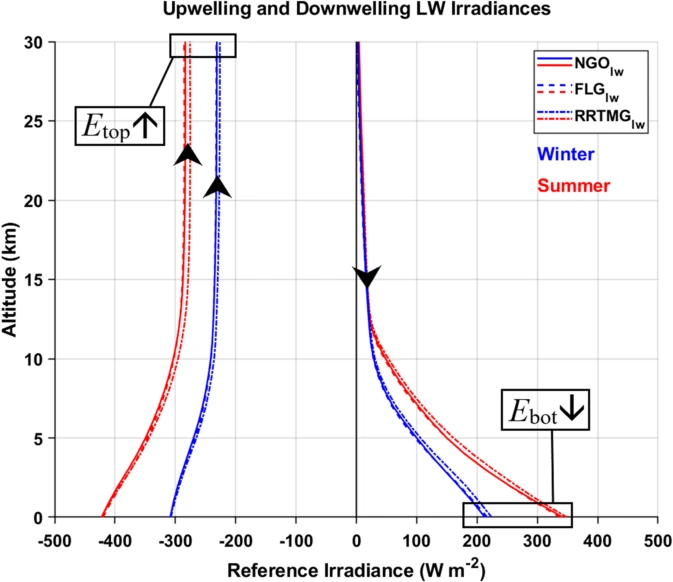
The change in the state of sky from cloudy to cloudless (or vice versa) comprises an additional [...]
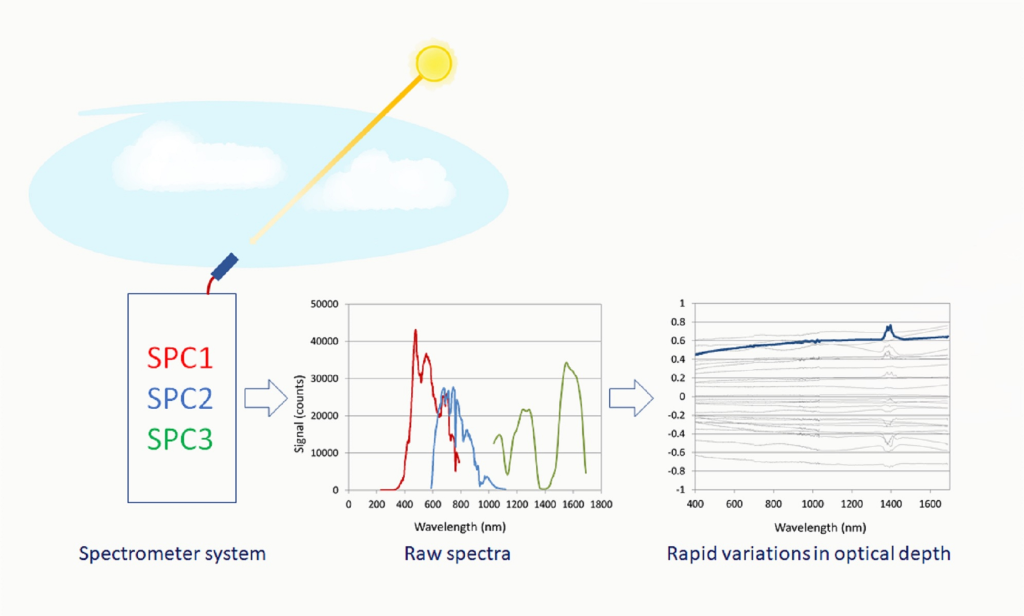
A method for determining rapid variations in atmospheric optical depth is proposed. The method is based upon [...]