
10-15% of cloudless-to-cloud transition occurrence, assessed from downwelling longwave measurements
Image: clouds reflected onto a pyrgeometer dome In a recently published article, the authors have reinforced the idea that among 10-15% of sky conditions would correspond to the cloudless-to-cloud transition zone. This result has been found from pyrgeometer measurements taken at the radiometric station of the Environmental Physics Group (Department of Physics – Polytechnic School – Universitat de Girona). The extension of methods for estimating the occurrence of transition conditions (or the spatial extent of the transition region) is largely significant, given the importance of clouds’ effects on the climate balance. The article, Assessment of cloudless-to-cloud transition zone [...]
New Nubesol-2 member
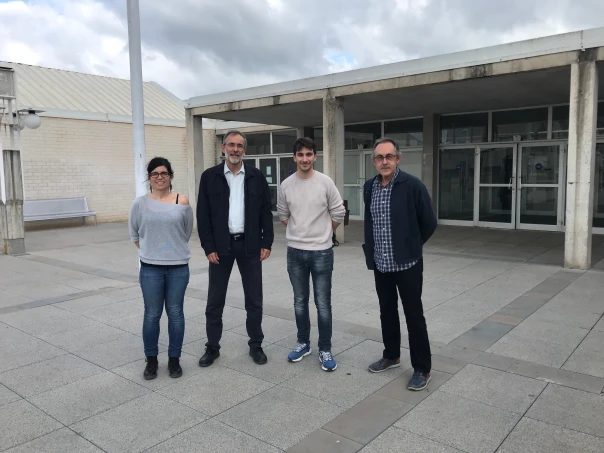
In November 2022, Jaume Ruiz de Morales has joined the Nubesol-2 project. He has obtained a IFUdG2022 scholarship from the University of Girona for developing his doctoral thesis. In connection with his doctorate, Jaume will support some tasks of the project, as the research on the cloud-aerosol transition zone from the experimental point of view. His thesis will be devoted to the use of lidar based observations to characterize the transition zone. Some members of the Nubesol-2 team. From left to right: Yolanda Sola, Josep Calbó, Jaume Ruiz de Morales and Josep-Abel González.
Members of NUBESOL-2 project are attending the IRS2022 meeting
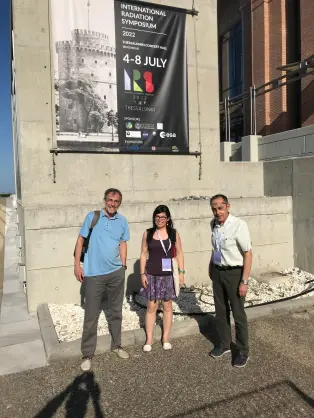
The International Radiation Symposium is organized every 4 years by the International Radiation Commission (IRC) of the International Association of Meteorology and Atmospheric Sciences (IAMAS). This edition should have taken place in 2020, but it was postponed until now due to the Covid-19 pandemic. The meeting is being hosted by the Aristotle University of Thessaloniki, in Thessaloniki, Greece. osep Calbó, Yolanda Sola and Josep-Abel González at the IRS2022, Thessaloniki (Greece). Josep-Abel González, Josep Calbó and Yolanda Sola, researchers from the University of Girona and the University of Barcelona involved in the NUBESOL-2 project are attending the meeting and [...]
Cloud-Aerosol Transition Zone: longwave radiative effect based on CERES observations
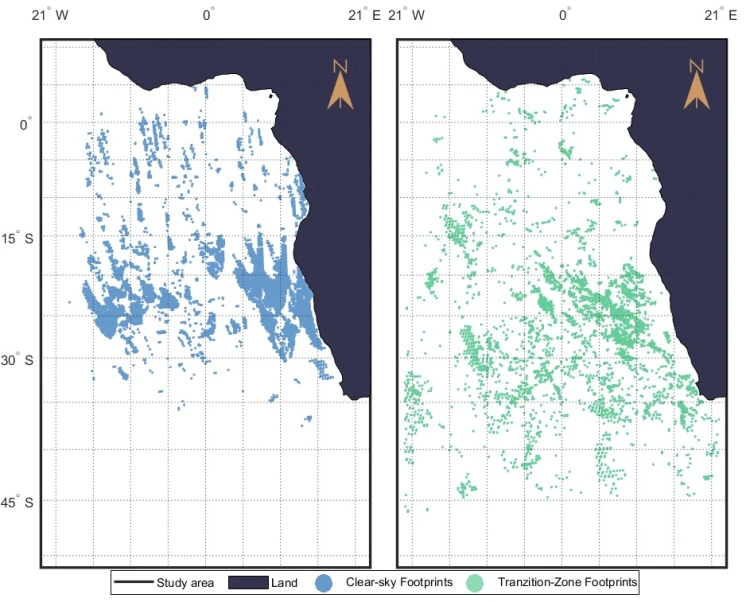
By Babak Jahani, Hendrik Andersen, Josep Calbó, Josep-Abel González and Jan Cermak. Publication: https://doi.org/10.5194/acp-22-1483-2022 The study presents an approach for quantification of cloud-aerosol transition zone broadband longwave radiative effects at the top of the atmosphere (TOA) during daytime over the ocean, based on satellite observations and radiative transfer simulation. The authors used several products from MODIS (Moderate Resolution Imaging Spectroradiometer) and CERES (Clouds and the Earth’s Radiant Energy System) sensors for the identification and selection of CERES footprints with horizontally homogeneous transition zone and clear-sky conditions. For the selected transition zone footprints, radiative effect was calculated as the difference between [...]
Columnar properties in “El Montsec” during dust outbreaks
The sun-sky radiometer Cimel CE-318 located at El Montsec station detected the multiple Saharan dust intrusions during February and March. The Cimel instrument belongs to AERONET network, who automatically processed data (level 1.5). Cimel sun-sky radiometer at the regional background station El Montsec The Angström exponent showed values lower than 0.5 during some days, especially from 20th February to 5th March, indicating the dominance of coarse particles. Some of the episodes were also characterized by high AOD. Variation of AOD and Angstrom exponent during February and March 2021 The strongest outbreak was detected on 5th March, [...]
Saharan dust intrusions along February 2021
In recent weeks several episodes of intrusion of Saharan dust have affected the Iberian Peninsula and other parts of Europe. We show here how these episodes have been detected by different instruments which are routinely measuring in the stations managed by Nubesol-2 researchers. We can observe, in the movie for February 3rd, the Moon trajectory during the nighttime, and the Sun trajectory during the daytime. Both Moon and Sun show reduced aureole, in correspondence with the low aerosol load in the atmosphere for that period. Contrarily, in the movie showing sky evolution along February 6th, and during the daytime period, [...]
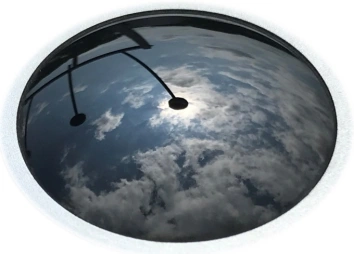
Image: clouds reflected onto a pyrgeometer dome In a recently published article, the authors have [...]
In November 2022, Jaume Ruiz de Morales has joined the Nubesol-2 project. He has obtained a IFUdG2022 [...]
The International Radiation Symposium is organized every 4 years by the International Radiation Commission (IRC) of the [...]
By Babak Jahani, Hendrik Andersen, Josep Calbó, Josep-Abel González and Jan Cermak. Publication: https://doi.org/10.5194/acp-22-1483-2022 The study presents [...]
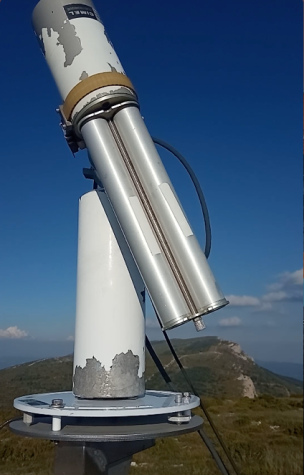
The sun-sky radiometer Cimel CE-318 located at El Montsec station detected the multiple Saharan dust intrusions during [...]
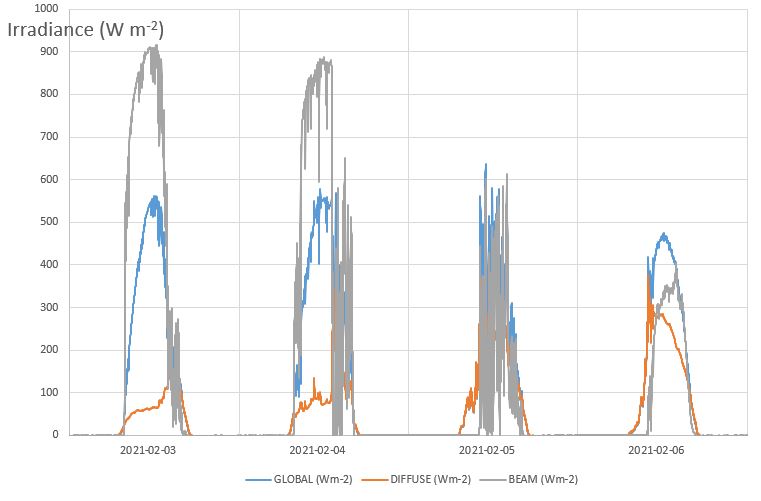
In recent weeks several episodes of intrusion of Saharan dust have affected the Iberian Peninsula and other [...]